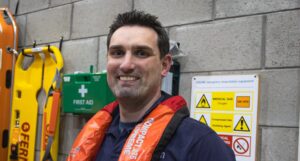
If there’s one word often used to describe the UK commercial fishing industry, it’s resilient. Fishermen adapt constantly to changing conditions – environmental, economic and operational. But resilience alone isn’t enough. Because when something goes wrong at sea, the consequences don’t stop with the vessel or the crew on board.
That’s why risk prevention and personal safety remain so critical in commercial fishing – not just for fishermen themselves, but for the wider communities and industries that rely on them coming home safe.
Seafish and its approved training provider network have delivered safety training for more than 40 years and one thing that’s clear is that no matter the experience level of a fisherman or the number of trips they’ve taken out to sea, nobody is exempt from risks to safety. And these risks present in all sorts of ways: slips, flooding, sudden movements impacting vessel stability and even equipment failure are all hazards that can impact both crew and vessel safety.
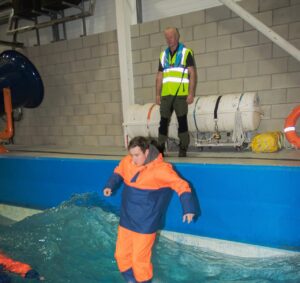
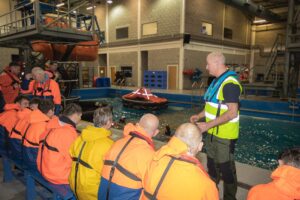
Today, unfortunately, accidents at sea remain far too common. They often unfold in a matter of seconds, leaving little time to react. But, when an incident occurs, the consequences are immediate and devastating for crews, and the ripple effects extend far beyond the vessel itself.
Accident reports repeatedly identify Man Overboard (MOB) incidents as the leading, or consequential cause, of fatalities in the commercial fishing sector. While every incident is unique and, despite countless reasons why accidents may occur, there are some clear underlying factors that we see and hear time and time again that point to why safety is not always prioritised as it should be.
Firstly, fishermen face a raft of operational, systematic and personal challenges, so there’s pressure from many angles and a multitude of things to think about. Weather, restricted grounds, fuel and maintenance costs, inspections, insurance requirements and costs and persistent crew shortages are only some of the competing demands fishermen must constantly navigate.
Secondly, risk is not always consciously accepted. In many cases, it is taken on gradually or unintentionally, as operational pressures normalise behaviours that appear routine rather than hazardous. Decisions made in the moment may seem reasonable or even controllable, without the full risk being immediately visible. However, when these decisions interact with other factors, their cumulative effect can create significant and often unrecognised safety vulnerabilities.
In addition to these factors, recent Marine Accident Investigation Branch (MAIB) reports consistently highlight inadequate risk assessments as a common underlying contributor to accidents at sea. This is particularly evident for single‑handed creel vessels, where a recurring cause of serious incidents is fishermen operating too close to shooting gear, increasing the risk of entanglement.
Against this backdrop, a planned and written risk assessment is not simply a legal requirement, but one of the most effective tools available to fishermen to counter unforeseen or underestimated risks. By systematically identifying hazards and understanding how risks can interact and escalate, meaningful risk management helps protect fishermen, their crews and their livelihoods.
On single-handed creel vessels, the risk of entanglement should be considered a crucial part of any risk assessment. Critical steps to avoid entanglement could include not intervening when things snag, stopping the gear to deal with snags rather than attempting to sort it while still shooting pots, and employing stop and alert systems onboard vessels in case of Man Overboard (MOB) occurrences.

Whilst working at sea will always present dangers, accidents and losses should not be inevitable. Reducing risks in ways like this improves the likelihood that vessels and crews return home and dry – sustaining not only themselves, but the businesses and coastal communities that depend on them.
The members of the Home and Dry Fishing Safety Forum (formerly FISG) are united by a shared ambition to achieve zero preventable deaths at sea. To enable this, and encourage fishermen to put the right safety measures into action, behaviour change is what’s needed. It remains fundamental to continually raise awareness of the issues and reinforce the reasons why safety is paramount at all times on a fishing vessel, but safety campaigns also need to take account of the cultural, social and emotional dimensions of working in the industry.
When a fisherman heads out to sea and then back home, they carry far more than their catch. Every job at sea can support between 8 and 15 jobs onshore, so keeping fishermen safe means stronger futures and stable livelihoods for many others in their communities. Changing behaviour at sea, therefore, requires shared responsibility and action beyond the vessel.
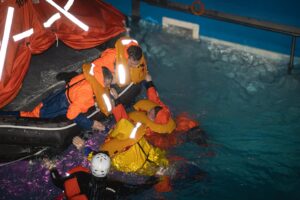
To date, the industry’s collaborative work on safety, including the activities of the Home and Dry Safety Forum, is making a difference. Over the last five years, we’ve seen both demand for and attendance at safety training courses increase dramatically, from 382 courses and 2,396 attendees in 2020-21 to 746 courses and 4,668 attendees in 2024-25.
And we’ve heard personal stories of safety in action. I was thrilled to receive news from David Gatt, skipper of the Audacious (BF83), of an investment in new Personal Locator Beacons (PLB’s) and a four-man life raft in case of an emergency MOB situation after attending a MOB Awareness training event in July 2025. We also received pictures of the crew of the vessel Golden Shore (N153) all wearing their PFDs correctly on deck after attending a similar course in Northern Ireland last October. It’s connections and stories like these that show the difference we can make simply by coming together, sharing learnings and recommendations and keeping collective safety knowledge up-to-date.
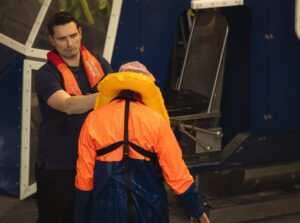
Whilst these successes are absolutely worth celebrating, there remains work to be done. Tragically, between mid-December and mid-January, two fishermen lost their lives in man overboard incidents in Scotland and Northumberland. These losses are a stark reminder that, despite progress, safety risks remain, and the consequences can be irreversible.
Our upcoming Home and Dry communications campaign builds on the reality that safety at sea is a shared responsibility, and that keeping fishermen safe should be everyone’s goal. By bringing together voices from across the industry and focusing on very real risks, we aim to both advocate for the integral role fishermen play economically, culturally and socially and to support the behaviour change needed to make zero preventable deaths at sea a reality. This is a goal the whole industry has a stake in achieving.
Home and Dry is a safety initiative run by the Home and Dry Fishing Safety Forum. Find out more about how to write and use effective risk assessments here and how to stay safe aboard single handed potting vessels here.